If you are dealing with hair loss, the first thing most people tell you is to either accept it or get a transplant. But there is a wide middle ground between those two options — and for most men, that middle ground is exactly where the right answer lives.
Non-surgical hair restoration covers a broad range of treatments and solutions that address hair loss without surgery, without downtime, and in many cases, without waiting months to see results. At Ace of Fades 212 in Midtown Manhattan, Marcos Monje has spent over two decades helping men navigate these options and walk out looking like themselves again — just with better hair.
This guide breaks down every legitimate non-surgical hair restoration method, what each one actually does, who it works for, and how they compare.
What Is Non-Surgical Hair Restoration?
Non-surgical hair restoration refers to any treatment or solution that addresses hair loss without a surgical procedure. That includes treatments designed to stimulate new hair growth from existing follicles, as well as solutions that replace hair entirely with a natural-looking system attached to the scalp.
The key distinction is this: some non-surgical methods try to reverse or slow hair loss at the follicle level. Others do not treat the follicle at all — instead, they replace what is lost with results that are immediate, fully customizable, and undetectable when done correctly.
Both approaches are valid. The right choice depends entirely on your degree of hair loss, your goals, your timeline, and your budget.
Non-Surgical Hair Restoration Methods: The Full Breakdown
1. Hair Systems — The Most Immediate and Reliable Option
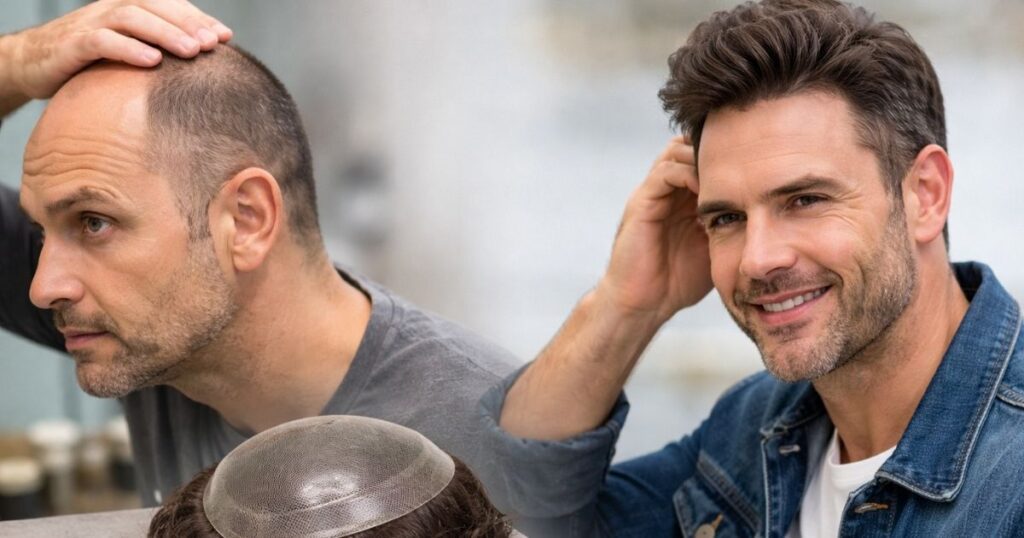
A hair system is a custom-fitted, non-surgical hair replacement unit that adheres directly to the scalp using medical-grade adhesive or tape. It is not a wig. It does not clip on or slide around. When professionally installed and blended, it is completely undetectable — even up close, even in wind, even during physical activity.
This is what Ace of Fades 212 specializes in, and it is the most effective non-surgical hair restoration option for men with moderate to advanced hair loss who want immediate, full results without waiting for medications to work — or gambling on whether they will work at all.
Hair systems are made from either human hair or high-quality synthetic fiber, with human hair being the premium choice for a completely natural look and feel. The base — the part that sits on your scalp — comes in lace, skin (polyurethane), or mono materials, each with different tradeoffs in breathability, durability, and hairline realism.
At our studio, every unit is custom-cut, colored, and styled to match your natural hair texture, your face shape, and your personal style. Installation takes two to three hours. Most clients come in for maintenance every two to four weeks, and a well-maintained system typically lasts three to six months before needing replacement.
This is the best long-term non-surgical hair restoration approach for men who want consistency, control, and results that do not depend on how their follicles respond to treatment.
Best for: Men with moderate to advanced hair loss, androgenetic alopecia, traction alopecia, alopecia areata, or anyone who wants immediate full coverage.
2. Minoxidil
Minoxidil is the most widely used non-surgical hair restoration treatment for stimulating follicular growth. Sold over the counter as Rogaine, it works by widening blood vessels in the scalp, improving circulation to hair follicles, and extending the active growth phase of the hair cycle.
It is available as a topical solution or foam applied directly to the scalp, or in oral form by prescription. Topical minoxidil is the more commonly used option and produces solid results for many men, particularly in the early to moderate stages of male pattern baldness.
The catch is consistency. Minoxidil works only as long as you keep using it. Stop the treatment, and any regrowth typically reverses within a few months. It also takes three to six months of regular use before visible results appear, and it works significantly better when hair loss is caught early — once follicles have fully miniaturized and stopped producing hair, minoxidil cannot revive them.
Best for: Men in early to moderate stages of androgenetic alopecia who want to slow or partially reverse thinning.
3. Finasteride and Dutasteride
Finasteride (Propecia) is a prescription oral medication that blocks the enzyme responsible for converting testosterone into dihydrotestosterone (DHT) — the hormone that progressively miniaturizes hair follicles in men with genetic hair loss. By reducing DHT levels in the bloodstream, finasteride slows hair loss and can promote partial regrowth in some men.
Dutasteride works through the same mechanism but is considered more potent, reducing DHT levels more significantly than finasteride. It is not FDA-approved for hair loss specifically and is prescribed off-label.
Both medications require ongoing use — stopping either one will typically result in resumed hair loss within six to twelve months. They also carry potential hormonal side effects that some men find unacceptable, though these are not universal.
Best for: Men with diagnosed androgenetic alopecia who want a medical approach to slowing loss, ideally in conjunction with other treatments.
4. Platelet-Rich Plasma (PRP) Therapy
PRP is one of the more advanced non-surgical hair restoration treatments available. The process involves drawing a small sample of the patient’s own blood, spinning it in a centrifuge to concentrate the platelet-rich plasma, and injecting that concentrated plasma into the scalp.
Platelets contain growth factors that stimulate tissue repair and cellular regeneration. When injected into areas of hair thinning, they can activate dormant or weakened follicles, improve blood supply to the scalp, and encourage thicker, healthier hair growth.
PRP shows the strongest results for men in early to moderate stages of androgenetic alopecia where follicles are still present but underperforming. It typically requires an initial series of three to four treatments spaced four to six weeks apart, followed by maintenance sessions every six months or so.
It is more effective than minoxidil in certain cases and carries minimal risk since it uses the patient’s own blood. However, it is not a permanent fix, and results vary based on individual response.
Best for: Men who want a biologically-driven, non-pharmaceutical approach and have viable follicles that need stimulation.
5. Low-Level Laser Therapy (LLLT)
Low-level laser therapy — sometimes marketed as LaserCap non-surgical hair restoration — uses red or near-infrared light to stimulate hair follicles at the cellular level. The light energy is absorbed by mitochondria in the follicle cells, which improves their metabolic activity and promotes hair growth.
LLLT is FDA-cleared for treating androgenetic alopecia in both men and women. It is painless, non-invasive, and can be done in a clinic or at home using a wearable laser device or cap. Clinical studies show meaningful improvements in hair density with consistent use over several months.
Like other follicle-stimulating treatments, results require continued use to maintain. It works best in combination with other therapies and in the earlier stages of hair loss.
Best for: Men looking for a drug-free, non-invasive way to complement other treatments or those who prefer at-home options.
6. Scalp Micropigmentation (SMP)
Scalp micropigmentation is a specialized cosmetic tattooing technique where tiny dots of pigment are applied to the scalp to mimic the appearance of hair follicles. It creates the illusion of a closely cropped, full head of hair or reduces the visual contrast between scalp and thinning areas.
SMP works exceptionally well for men who shave their heads or maintain very short hair, as the pigment dots blend with the existing stubble. It is also useful for masking scars from hair transplants or injuries. Results can last several years with minimal maintenance.
The limitation is that SMP does not add length or texture — it works best for a shaved or buzzed aesthetic. For men who want to style their hair, grow it out, or have a natural-looking full head of hair, a hair system provides results SMP cannot.
Best for: Men who prefer a short, clean look and want to fill in thinning areas or blend a receding hairline.
Non-Surgical vs. Surgical Hair Restoration: How They Compare
Hair transplant surgery — either FUT or FUE — involves harvesting healthy follicles from the back or sides of the scalp and implanting them into balding areas. It is a permanent solution, but it comes with significant considerations: high cost (typically $5,000–$15,000+), a recovery period of several weeks, and results that take 12 to 18 months to fully appear.
It also requires sufficient donor hair, which means men with advanced or diffuse hair loss may not be good candidates. And results, while often good, are not guaranteed.
Non-surgical hair restoration — particularly hair systems — provides immediate results at a fraction of the cost, with no recovery time and no surgical risk. The ongoing maintenance commitment is the main tradeoff.
For many men, a hair system is not a fallback from surgery — it is simply the better choice for their situation, their timeline, and their life.
Non-Surgical Hair Restoration Cost: What to Expect
Cost varies significantly depending on the method:
Hair systems at Ace of Fades 212 start at $750 for a full professional installation. Ongoing maintenance visits run every two to four weeks. Replacement units are typically needed every three to six months depending on the type of system and how well it is maintained.
Minoxidil is inexpensive and available over the counter, though prescription oral minoxidil costs more. The ongoing nature of the treatment means costs accumulate over years.
PRP therapy typically runs $500–$1,500 per session, with an initial series of three to four sessions recommended.
LLLT devices for home use range from a few hundred to over a thousand dollars, with no ongoing session costs once purchased.
Scalp micropigmentation typically costs $1,500–$4,000 depending on the extent of coverage needed.
For men who want immediate, full results, a professionally installed and maintained hair system delivers the highest value per dollar for the results achieved.
Frequently Asked Questions
What is the best non-surgical hair restoration option for men with advanced hair loss?
A professionally installed hair system is the most effective option — it delivers immediate, full coverage regardless of how advanced the loss is, unlike follicle-stimulating treatments that need viable follicles to work.
Is non-surgical hair restoration permanent?
No non-surgical treatment is permanent. Hair systems need periodic maintenance and replacement, while medications like minoxidil and finasteride require ongoing use to maintain results.
Can women use non-surgical hair restoration?
Yes. Minoxidil is FDA-approved for female pattern hair loss, and PRP, LLLT, and hair systems are all effective options for women experiencing thinning or significant hair loss.
How long does it take to see results?
Hair systems give you immediate results on installation day. Minoxidil, PRP, and laser therapy typically take three to six months of consistent use before visible improvement appears.
What is the most advanced non-surgical hair restoration solution available?
A custom lace-front or skin-base human hair system, professionally installed and blended, gives the most natural and complete result — with zero waiting period.
Get Started at Ace of Fades 212 in NYC
If you are ready to explore your non-surgical hair restoration options, Ace of Fades 212 offers private, one-on-one consultations with Marcos Monje at our Midtown Manhattan studio. Whether you are interested in a custom hair system, want to understand your options, or are bringing your own unit for professional installation, we will give you an honest assessment and a result that looks completely natural.
Book your appointment today.
📞 (646) 245-2346 | 127 E 59th St, Suite 60, New York, NY 10022