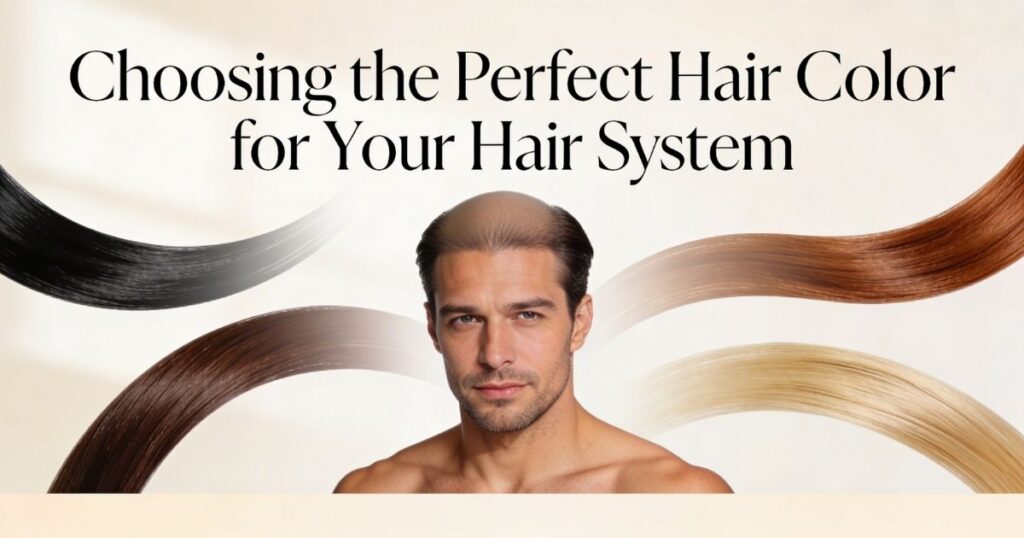
Introduction: Why Hair Color Match Is Everything
You’ve selected the perfect hair system base, the right density, and the ideal hairline design. But if the color doesn’t match? Everything falls apart. A hair system that’s even one shade off becomes immediately noticeable—and not in a good way.
Hair color is often the difference between a hair system that looks completely natural and one that screams “I’m wearing a hairpiece.” Getting the color right is non-negotiable.
The good news? It’s completely achievable. With the right approach and a little patience, you can get a hair color match so perfect that nobody will ever suspect you’re wearing a system. At Ace of Fades, we’ve helped hundreds of men nail this critical step. In this guide, we’ll share exactly how to do it.
Why Hair Color Matching Is More Complicated Than You Think
The Problem: Hair Isn’t One Color
Here’s something most guys don’t realize: your natural hair isn’t actually one uniform color. Look closely in the mirror. Your hair has depth, variation, and subtle gradations. The roots might be slightly darker. The mid-lengths and ends have sun exposure, giving them a lighter tone. Some hair has warmer tones, while other sections have cooler undertones.
This natural variation is exactly what makes hair look real.
If your hair system is a single, uniform color throughout, it will look artificial no matter how perfect that color is. Real hair has complexity. It has movement in color. It has personality.
Hair Color Graduation: Nature’s Formula
Your natural hair follows a specific pattern called “color graduation.” Here’s how it works:
- The Back (Crown): Darkest hair color (roots are always darker than the rest)
- The Sides (Temples): Typically lighter than the back, with more color variation
- The Front (Hairline & Frame): Lightest section, due to natural sun exposure over your lifetime
This gradient happens naturally—it’s how your hair has evolved with sun exposure as you’ve aged. Your hair system needs to follow this same pattern to look completely authentic.
The Gray Hair Factor
If you have gray hair, the color graduation becomes even more complex. Gray hair isn’t distributed evenly. Instead:
- Gray concentrations are highest at the temples and hairline (the face frame)
- The back of the head typically has less gray, even if the front has significant gray
- Gray percentage increases with age (10% gray at 40, 25% gray at 45, 50%+ gray at 50+)
Choosing the wrong gray percentage—or having uniform gray throughout—immediately signals “this is fake.” The human brain knows that real hair doesn’t gray uniformly.
The Undertone Issue: Warm vs. Cool
Beyond the basic color (brown, black, blonde), every hair color has an undertone: warm, cool, or neutral.
Warm Undertones include golden, copper, honey, and reddish tints. These colors look warmer in sunlight and catch light beautifully.
Cool Undertones include ash, smokey, and ashy-brown tones. These colors look more sophisticated in fluorescent lighting and have a refined, muted quality.
Your natural hair has a specific undertone profile. If your hair system’s undertone doesn’t match, the mismatch becomes glaringly obvious—especially to people who see you regularly.
Step 1: Identify Your Exact Natural Hair Color
The Professional Color Level System
Hair professionals use a standardized numbering system called “levels” that range from 1-10:
Hair Color Levels (1-10):
- Level 1: Jet black (nearly black with no brown visible)
- Level 2: Off-black (black with slight brown undertones)
- Level 3: Dark brown (dark with visible brown)
- Level 4: Medium brown (standard brown color)
- Level 5: Light brown (medium brown, leaning lighter)
- Level 6: Dark blonde (light brown with golden tones)
- Level 7: Medium blonde (true blonde)
- Level 8: Light blonde (pale blonde)
- Level 9-10: Very light blonde/platinum (rarely natural)
How to Determine Your Level (No Guessing)
Step 1: Look at Your Hair in the Right Light
Don’t check your hair color in bathroom lighting. Bathroom lights are notoriously yellow and misleading. Instead:
- Stand near a window with natural daylight (but not in direct sunlight)
- Use a hand mirror to get a side view
- Look at the mid-length of your hair, not the roots (roots are always darker)
Step 2: Sample Multiple Areas
Your hair color isn’t uniform. Check three areas:
- The Back/Crown: Usually 1-2 levels darker than other areas
- The Sides/Temples: Often the most “true” representation of your color
- The Front/Hairline: Typically 1-2 levels lighter due to sun exposure
Step 3: Compare Against a Color Chart
If you’re still unsure, use a professional color chart (also called a “color ring”). Place the color samples next to your hair in natural light and compare side-by-side.
Pro Tip: The most accurate reading comes from the mid-section of hair at the temples or sides—not the very front (too light from sun) and not the very back (too dark from roots).
Identifying Your Undertone
Once you know your level, identify your undertone:
Warm Undertone Indicators:
- Hair looks golden or honey-tinted in sunlight
- Hair looks brassy or reddish in some lighting
- You look better in warm-colored clothing (gold, warm brown, rust)
- Your veins appear greenish
Cool Undertone Indicators:
- Hair looks ashy or smokey in sunlight
- Hair doesn’t appear golden, even in bright light
- You look better in cool-colored clothing (silver, blue, cool gray)
- Your veins appear bluish or purple
Neutral Undertone Indicators:
- Hair looks good in both warm and cool lighting
- You look equally good in warm and cool clothing colors
- Your veins appear both green and blue
This undertone identification is crucial because it determines which hair system colors will blend seamlessly with your natural hair.
Step 2: Account for Color Graduation & Gray Hair
Planning Your Color Graduation
Now that you know your primary color level and undertone, you need to plan how your hair system’s color will graduate to match natural hair growth patterns:
If You Have No Gray:
- Back/Crown: Your primary color level (this is where it’s darkest in natural hair)
- Sides/Temples: Same primary color (or 0.5 shades lighter for subtlety)
- Front/Hairline: 0.5-1 shade lighter than back (mimics sun exposure effect)
If You Have Gray (10-30%):
- Back/Crown: Minimal gray (0-10%, mostly your natural brown color)
- Sides/Temples: Moderate gray (15-20%, noticeably grayed but not overwhelmingly)
- Front/Hairline: Higher gray (25-35%, visibly grayed to frame your face)
This natural distribution of gray is what makes a hair system look authentic. People expect to see more gray at the front and temples—that’s how aging works.
If You Have Significant Gray (30%+):
- Full Gray System: Consider ordering a system with uniform gray (salt-and-pepper effect)
- Or Graduated Gray: Back has less gray (base color + 20% gray), front has more (base color + 50-70% gray)
The “Two-Shade Rule”
Professional stylists follow the “two-shade rule” when changing hair color: never go more than two shades lighter or darker than your current color in a single change.
For hair systems, this rule applies differently—you’re not chemically processing your hair. However, it’s still wise to stay within this range because:
- It looks more natural (gradual changes look intentional, dramatic changes look suspicious)
- It blends better with your remaining natural hair
- It’s easier to adjust if the color isn’t perfect on arrival
The Three Methods to Match Your Hair System Color (Ranked by Accuracy)
#1: Send a Hair Sample (Most Accurate – 95%+ Match)
This is the gold standard. Nothing beats giving the manufacturer your actual hair to match against.
How to Submit a Hair Sample:
Step 1: Collect the Right Sample
- Hair length: 2-3 inches minimum (6+ inches is ideal for better accuracy)
- Hair quantity: Collect a small bundle, about the thickness of a pencil
- Collection method: Pluck from three different areas (back, sides, front) to represent color variation
- Avoid: Hair from directly under the sun or very top of head (both are unrepresentative)
Step 2: Prepare the Sample
- Place the hair in a small ziplock bag or envelope
- Include a note with your name, order number, and hair location (back/sides/front)
- Include any notes about color variation (e.g., “graying at temples,” “some sun-bleached pieces”)
Step 3: Ship Correctly
- Use certified mail with tracking (we provide a shipping address after your order)
- Ship early—the factory needs time to analyze and match your sample
- Typically takes 1-2 weeks from receipt for your system to be completed
Why This Works Best:
The factory can literally place your hair sample next to the hair system under multiple lighting conditions. They can see your exact undertone, your natural color graduation, and any gray distribution. There’s no guessing—just direct comparison.
The Trade-Off: This method requires patience. You’ll wait longer for your system (8-10 weeks total), and you need to be comfortable mailing out your own hair.
Success Rate: 95%+ perfect color match
#2: Physical Color Ring / Swatch (Good – 85%+ Match)
A color ring is a physical sample containing actual hair swatches of all available colors. You match your hair directly against the ring in person.
How to Use a Color Ring:
Step 1: Order the Color Ring
- Cost: Typically $25-$75 (refundable when you purchase a system)
- Shipping: 3-5 business days
- What arrives: A ring with 40-50 hair color swatches labeled with color codes
Step 2: Test in Multiple Lighting Conditions
This is critical. Hair color looks different under different lighting:
- Natural daylight: Hold the ring outside (not in direct sun) and match against your hair
- Fluorescent lighting: Test indoors under office/bathroom lights (this is how people will see you most)
- Evening/warm lighting: Test under indoor lamps to see how your hair looks at night
The color that looks best across all three lighting conditions is your winner.
Step 3: Note Multiple Color Options
- Don’t just pick one color—note 2-3 options that look close
- This gives you backup options if your first choice isn’t quite right
- Order codes matter: make sure you note the exact color code (e.g., “Color 8” not “Light Brown”)
Why This Works Well:
You’re testing real hair in real lighting. You get instant feedback. You can see exactly what the color will look like before ordering. And if you match carefully, the results are excellent.
The Trade-Off: Some people struggle with color matching (not everyone has a trained eye for color). Also, lighting in your home might not represent how people will see you in various settings.
Success Rate: 85-90% perfect color match (with careful testing)
#3: Photo Reference (Fastest – 75%+ Match)
You submit photos of your natural hair, and the Ace of Fades team analyzes them to recommend colors.
How to Submit a Photo Reference:
Step 1: Take the Right Photos
- Lighting: Natural daylight only (no flash, no artificial light)
- Hair style: Wear your hair down naturally (no gel, no product that changes shine)
- Angles: Take photos from front, side, and back views
- Coverage: Show full hair length from roots to tips
- Avoid: Direct sunlight (causes washed-out colors), wet hair (appears darker), or recently dyed hair
Step 2: Submit with Notes
- Include any color information you know (level, undertone, gray percentage)
- Mention if your hair color varies (graying, sun-bleached, etc.)
- Describe your current hair loss pattern (helps them match your hairline color to where you have remaining hair)
Step 3: Review Recommendations
- Our team will recommend 2-3 color options based on your photos
- Ask questions if you’re uncertain
- Consider ordering a color ring if the photo analysis isn’t clear
Why This Works (Sometimes):
It’s fast and convenient. You get expert recommendations instantly. For most men, photo analysis by professionals gets close enough for a great match.
The Trade-Off: Cameras lie. Monitor color settings, compression, and lighting can all affect how your hair appears in photos. Computer screens also vary widely in color accuracy. What looks perfect on your screen might be off in person.
Success Rate: 75-85% perfect color match (varies with photo quality)
Special Situation: Matching Gray Hair in Your Hair System
Understanding Gray Percentages
Hair systems don’t offer true “blended” gray like natural hair. Instead, manufacturers blend synthetic gray fibers throughout. A “50% gray” system means 50% of the hair is gray and 50% is your base color.
Gray Distribution Patterns:
- 10% Gray: Minimal gray, barely noticeable—looks like early graying
- 25% Gray: Noticeable gray, looks natural—typical for 40s men
- 50% Gray: Distinctly gray, salt-and-pepper appearance—typical for 50s+ men
- 75-100% Gray: Full gray/white hair—very distinguished but visible system wear shows more
Pro Tip: Location-Specific Gray Ordering
Some manufacturers allow you to specify gray distribution by location:
- Back/Crown: Lower gray percentage (10-20%)
- Sides/Temples: Moderate gray percentage (25-30%)
- Front/Hairline: Higher gray percentage (35-50%)
This graduated approach looks significantly more natural because it mirrors how real hair grays (more at the face frame, less at the back).
The Gray Hair Challenge: Preventing Brassiness
Gray hair tends to yellow and discolor faster than brown hair. To keep your system looking fresh:
- Use purple/ash-toning shampoos monthly (reduces yellow tones in gray)
- Protect from direct sunlight when possible (sun fades and yellows gray)
- Avoid chlorinated water (swimming requires brief removal)
- Store in cool, dark conditions between wears
Matching Your Hair System to Your Skin Tone
How Skin Tone Affects Hair Color Perception
Here’s something most men don’t know: the same hair color looks different on different skin tones. Your skin tone acts as a “background filter” that changes how people perceive your hair color.
Determine Your Skin Tone
Fair/Light Skin
Best hair colors: All colors work, but ash/cool tones often look more striking. Golden tones can look too warm.
- Level 1-2 (Black): Clean, dramatic look
- Level 3-4 (Dark Brown): Professional, classic
- Level 5-7 (Blonde): Striking contrast (consider if your natural hair was blonde)
Medium Skin (Most Common)
Best hair colors: Warm browns work beautifully. Golden and honey tones enhance warm undertones.
- Level 2-4 (Black-Dark Brown): Safe, natural-looking
- Level 4-6 (Medium-Dark Brown): Ideal range for most men
- Warm undertones enhance medium skin perfectly
Olive Skin
Best hair colors: Ash tones and cool brunettes work better than warm tones. Warm colors can clash.
- Level 2-5 (Black-Light Brown): Ashy tones recommended
- Avoid overly golden colors (can look unflattering)
- Cool undertones complement olive skin
Deep/Dark Skin
Best hair colors: Rich, deep colors look stunning. Warm tones and ash tones both work well depending on your specific undertone.
- Level 1-3 (Black-Dark Brown): Deep, lustrous colors look exceptional
- Rich brown and golden tones are striking
- High contrast between skin and hair looks polished
The Quick Test: Hold a piece of white paper next to your face. If your skin looks yellow/warm next to the paper, you have warm undertones. If your skin looks pink/cool next to the paper, you have cool undertones. This determines which hair color temperatures will look best on you.
Red Flags: Colors That Will Look Fake (Avoid These)
Too Uniform Color Throughout
The Problem: A hair system with identical color from front to back looks artificial because real hair naturally graduates.
The Solution: Specifically request color variation at different locations, or accept that your system will need some styling to break up the uniformity.
Overly Shiny/Glossy Color
The Problem: Some hair systems ship with a plastic sheen that looks unnatural. This usually comes from manufacturing residue.
The Solution: Gentle shampooing removes the shine. A professional wash before first wear can eliminate this immediately.
One-Dimensional Undertone
The Problem: A system with only warm OR only cool tones looks artificial. Real hair has subtle undertone variation.
The Solution: Choose systems with “multi-tonal” descriptions, or blend your color by using two very similar shades (slightly warm and slightly cool) in different areas.
Completely Unnatural Color (For Your Age/Ethnicity)
The Problem: Men sometimes order colors that don’t match their original hair color or ethnicity. This screams “fake hair system.”
The Solution: Stay true to your natural hair color unless you have a specific reason to change (e.g., you had previously dyed your hair). Hair system color should look like your “original” hair, not a dramatic change.
Mismatched Gray Percentage
The Problem: Uniform gray throughout (or no gray when you have significant gray) immediately looks fake.
The Solution: Order location-specific gray percentages, or embrace a full gray system if appropriate for your age.
The Color Matching Process: Your Step-by-Step Action Plan
Week 1: Identify your natural hair color level and undertone using natural lighting and a color chart if available.
Week 2: Decide which matching method makes sense for you:
- Maximum accuracy needed? → Send a hair sample
- Want to see colors in person? → Order a color ring
- Need a quick decision? → Submit photo references
Week 3: Complete your matching method (submit sample, test color ring, or send photos).
Week 4: Review any feedback or recommendations from Ace of Fades and confirm your color selection before your system is manufactured.
Week 5-8: Your system is manufactured with your exact color match.
Week 9: Your system arrives. Before wearing it, do a final color check in natural daylight against your hair to confirm the match is perfect.
Week 10+: Wear with confidence knowing your color match is flawless.
After You Receive Your System: Color Confirmation & Adjustments
Unboxing: Do a Color Check Immediately
When your system arrives, check the color against your natural hair right away—before you apply it.
Testing Process:
- Stand in natural daylight (near a window)
- Hold the system next to your head
- Compare the back/middle/front sections
- Check undertone alignment
If the color matches perfectly: You’re done. Congratulations on nailing the match.
If the color is slightly off: This is common and often correctable with a professional color correction (see below).
If the color is significantly off: Contact us immediately. Most manufacturers offer one free remake if the color doesn’t match your approval.
Professional Color Correction (If Needed)
If your system’s color is close but not perfect, a professional hair colorist can make adjustments:
- Too light? Can be darkened with demi-permanent color
- Too dark? Can be lightened with clarifying treatments
- Wrong undertone? Can be neutralized with toner
- Needs more gray? Can be added with specialist techniques
Budget $50-$150 for professional color correction if needed.
Preventing Color Fading
Once your system has the perfect color, protect it:
- Minimize sun exposure (UV fades hair color)
- Use cool water for washing (hot water opens hair cuticles, releases color)
- Avoid chlorinated pools (chlorine accelerates color fading)
- Use color-safe shampoo and conditioner
- Limit heat styling (heat degrades color molecules)
With proper care, your system’s color will stay vibrant for 6-12+ months before needing replacement.
FAQ: Hair Color Matching Questions Answered
Q: How do I know if I’m “Level 5” vs “Level 6”?
A: If you’re genuinely unsure, you’re probably between them. In that case, order the color ring and test both colors in person. The one that looks most natural is your answer.
Q: Can I match a hair system color to a photo on my phone?
A: Not reliably. Phone cameras have color sensors that don’t accurately represent real hair color. Always use physical color swatches or our professional photo analysis service for best results.
Q: What if my natural hair color changes with the seasons (lighter in summer, darker in winter)?
A: Use your hair color from fall/winter as the baseline (that’s your “true” color). Summer lightening is sun damage, not your actual hair color.
Q: How many different colors should I get in my first system?
A: Start with one color that matches your primary natural hair color. Don’t order multiple color variations until you understand what works. Once you have a good system, future systems can explore subtle variations.
Q: My hair is dyed currently. Should I match my system to my dyed color or my natural color?
A: Match to your dyed color only if you plan to maintain that dye job. If there’s any chance you’ll stop dyeing your hair, match to your natural color instead. System color should represent what people will expect from your actual hair.
Q: Can I order a lighter or darker version than my actual hair color for a new look?
A: Technically yes, but we don’t recommend it for first-time users. A dramatic color change requires that you maintain dye in your remaining natural hair, which defeats the purpose of a hair system. Stay true to your natural color first; experiment later once you’re comfortable.
Q: How do I describe “my hair color” if I don’t know the level?
A: Describe it in everyday terms: “It’s dark brown, like a chocolate bar” or “It’s jet black, very dark” or “It’s a light brown with some gray at the temples.” Our team can translate everyday descriptions into color levels.
Q: What if my gray percentage varies from my temples to the back?
A: This is actually ideal and the most natural-looking option. Specify gray percentages by location: “15% gray at the back, 40% gray at temples” and we’ll create a graduated gray system.
Q: Can I see a preview of how the color will look before it ships?
A: Yes—if you submit a hair sample, we can send you a photo of your finished system with the color before it ships to confirm you’re happy.
The Bottom Line: Getting Your Color Right
Hair color matching isn’t complicated—it’s just a process. Follow these steps:
1. Identify your natural hair level and undertone in good lighting.
2. Choose a matching method (sample, color ring, or photo).
3. Account for natural color graduation and gray distribution.
4. Confirm the match when your system arrives.
5. Protect your system’s color with proper care.
The result? A hair system color match so perfect that people will think the hair growing from your scalp is completely natural. That’s the magic of getting color right.
At Ace of Fades, we’ve matched hundreds of men with their perfect hair system color. We know what works. If you’re ready to get your color match dialed in, let’s talk.
Ready to Get Your Perfect Color Match?
Don’t leave your hair system color to chance. Schedule a color matching consultation with Ace of Fades today. We’ll walk you through every option and ensure you get the perfect match on your first try. Your confidence is on the line. Get the color right.